


Views: 0 Author: Site Editor Publish Time: 2026-10-14 Origin: Site


Conveyor carryback and fugitive material spillage are not inevitable operational realities; they are symptoms of a failing or improperly specified cleaning system that directly impacts profitability and site safety. Belt conveyors and their cleaning systems rarely perform to perfection without active attention. Treating them as maintenance-free components ignores their operational limitations and guarantees eventual failure. An ineffective cleaning setup leads to accelerated component wear, unscheduled downtime, belt tracking issues, and excessive manual cleanup costs that drain maintenance budgets. Moving beyond temporary adjustments requires a systematic, evidence-based evaluation of blade wear patterns, tensioning mechanics, and material suitability to implement a reliable, long-term solution. We see too many plants accept shovel work as normal. You need to stop treating the symptom and fix the root cause at the head pulley.
Incorrect profiling and inadequate tensioning account for a significant majority (approximately 1 in 3 cases) of premature cleaner failures and material bypass.
Matching the blade material (e.g., polyurethane belt scraper vs. tungsten carbide) to the specific conveyed material and belt splice type is critical for optimal contact and belt safety.
A dual-cleaner system utilizing both a primary and secondary belt cleaner significantly reduces carryback compared to single-blade setups, especially with cohesive materials.
Regular inspection of the belt surface is mandatory; tears, gouges, and cupping will compromise the effectiveness of even the highest-tier cleaning systems.
Carryback occurs when conveyed material adheres to the return side of the belt instead of discharging at the head pulley. As the belt travels along the return run, this fugitive material dislodges and accumulates on the floor, structural supports, and rotating components. Material loss hits your budget twice. First, the spilled material represents lost product that cannot be sold or processed without incurring additional recovery costs. Second, the labor hours required for manual cleanup using shovels, skid steers, or vacuum trucks represent a massive drain on operational budgets. Maintenance personnel are forced to abandon preventative tasks to manage reactive cleanup operations.
Beyond direct labor costs, fugitive material inflicts severe secondary damage on the conveyor system itself. When carryback enters the return idlers, it rapidly degrades the bearing seals. The material mixes with the bearing grease, forming a highly abrasive grinding paste. This contamination leads to premature roller seizure. A seized idler acts as a friction brake against the moving belt. The belt will eventually saw right through the steel shell of the seized roller, creating a razor-sharp edge that slices the belt cover. Furthermore, material buildup on return rollers and snub pulleys alters their outer diameter. This uneven buildup forces the belt to wander off-center, leading to edge damage and structural friction. The acidic or moisture-retaining nature of many conveyed materials also accelerates the corrosion of the conveyor framework.
Damage Category | Mechanical Mechanism | Field Consequence |
|---|---|---|
Idler Failure | Abrasive material breaches labyrinth seals | Bearing seizure, shell wear, belt slicing |
Belt Mistracking | Uneven material buildup on snub pulleys | Edge fraying, structural frame damage |
Structural Decay | Moisture retention against steel frames | Accelerated rust, weakened supports |
Evaluating a Belt Cleaner requires establishing clear, quantifiable performance metrics. Industry standards, such as those outlined by the Conveyor Equipment Manufacturers Association (CEMA), provide guidelines for acceptable carryback levels based on the specific material and operational environment. A highly effective primary cleaner should remove between 85% and 95% of the bulk material adhering to the belt. The remaining fines and moisture are then managed by secondary systems. If visual inspections reveal a continuous layer of material passing the head pulley, the system is failing to meet basic operational baselines.
To establish a true baseline, operators should perform a physical carryback test rather than relying on visual guesses. Here is the standard field method:
Fabricate a catch pan that spans the entire width of the return belt.
Safely position the pan under the belt immediately after the cleaning system.
Hold the pan in place for exactly three complete revolutions of the conveyor belt.
Weigh the collected material and calculate the total carryback in pounds per hour based on belt speed.
Operators must also establish the expected operational lifespan and performance degradation curve of their standard cleaning blades. Under normal conditions, a new blade maintains an optimal angle of attack, providing maximum scraping efficiency with minimal friction. As the blade wears, its contact area increases, which subsequently reduces the applied pressure per square inch unless the tensioner is adjusted. Tracking this curve allows maintenance teams to determine whether a blade is wearing at a normal rate or if external factors are causing accelerated degradation.
The physical alignment of the cleaning blade against the head pulley dictates its entire operational success. Industry data demonstrates that approximately 1 in 3 cases of premature belt cleaner blade wear are caused by incorrect profiling against the conveyor. Profiling refers to the exact angle and position at which the blade meets the belt surface. If the installation geometry is flawed, even the most expensive cleaning system will fail rapidly.
An improper angle of attack forces the blade to fight the belt rather than glide against it. Think of the head pulley like a clock face. If you mount a primary blade too high (e.g., at the 2 o'clock position), you create a peeling angle. The blade will dig into the belt cover, causing severe chatter and high-frequency vibration. This vibration shatters the cleaning edge and destroys the tensioning mechanism. If you mount it too low (e.g., at the 4 o'clock position), you create a wiping angle. The material easily forces its way under the blade, lifting it away from the belt and rendering it useless. Misalignment against the head pulley—where the blade is not perfectly parallel to the pulley face—causes uneven wear. One side of the blade will wear down to the mounting spine while the other side barely makes contact.
A cleaning system relies on a uniform surface to maintain an effective seal. Belt tears, deep gouges, and uneven covers severely disrupt blade-to-belt contact. When a belt sustains damage from heavy impact or trapped fugitive material, the resulting gouges act as protected channels for carryback. The cleaning blade bridges across the top of these gouges, allowing material hidden within the depressions to pass right through the cleaning zone.
Damaged belts prevent even the best cleaners from making sufficient contact. Rigid blades, such as those made from solid tungsten carbide, are particularly vulnerable to surface irregularities. They cannot conform to the localized variations of a damaged or cupped belt. When the belt surface lacks uniformity, rigid blades leave microscopic gaps where fine, wet, or sticky materials easily escape. In older conveyor systems where the belt has developed a permanent concave cup, a flat, rigid blade will only clean the outer edges, leaving a thick strip of carryback running directly down the center of the return run.
Tensioning is the driving force that keeps the blade engaged with the belt. Both under-tensioning and over-tensioning create distinct failure modes that compromise the entire system. Relying on guesswork to set tension is a guaranteed path to failure.
Under-tensioning: A lack of sufficient pressure allows the hydrodynamic force of the conveyed material to push the blade away from the belt. This material bypass creates a wedge effect, forcing even more material under the blade. Eventually, the buildup on the face of the blade causes complete blinding, where the cleaner becomes a solid ramp of hardened material that no longer touches the belt.
Over-tensioning: Applying too much pressure accelerates blade wear exponentially. It increases conveyor drag, forcing the drive motor to draw more amperage and elevating energy consumption. Excessive tension generates extreme friction and heat, which can melt polyurethane blades or cause severe thermal damage to the belt cover. Over-tensioning also dramatically increases the risk of the blade catching and ripping out mechanical belt splices.
Uneven tensioning: When dual-sided tensioners are not adjusted equally, the blade applies heavy pressure on one side and floats on the other. This causes rapid, diagonal wear across the blade profile.
The physical and chemical properties of the conveyed material dictate how the cleaning system will react over time. Sticky, cohesive, or highly abrasive materials require specific troubleshooting approaches.
Chemical and polymer blinding is a severe issue in specialized applications like wastewater sludge handling, agriculture, or belt filter presses. When handling moisture-heavy materials heavily dosed with polymers, the material becomes highly adhesive. It sticks to the blade profile, rapidly building up until it bridges the gap between the blade and the chute wall. This blinding negates the cleaning edge entirely. Overcoming this requires specialized low-adhesion blade materials, constant tension adjustments, and sometimes the introduction of a low-volume water spray directed at the blade face to break the surface tension.
Rapid abrasive degradation occurs when handling hard, sharp materials like crushed quartz, iron ore, or glass cullet. These materials act like sandpaper against the cleaning edge. If the material flow is concentrated in the center of the belt, it will carve distinct troughs or channels directly into the blade. This channelling destroys the uniform cleaning edge, causing the blade to lose effectiveness after only a few hours of operation. Once a channel is formed, all subsequent material flows through that path of least resistance, completely bypassing the cleaner.
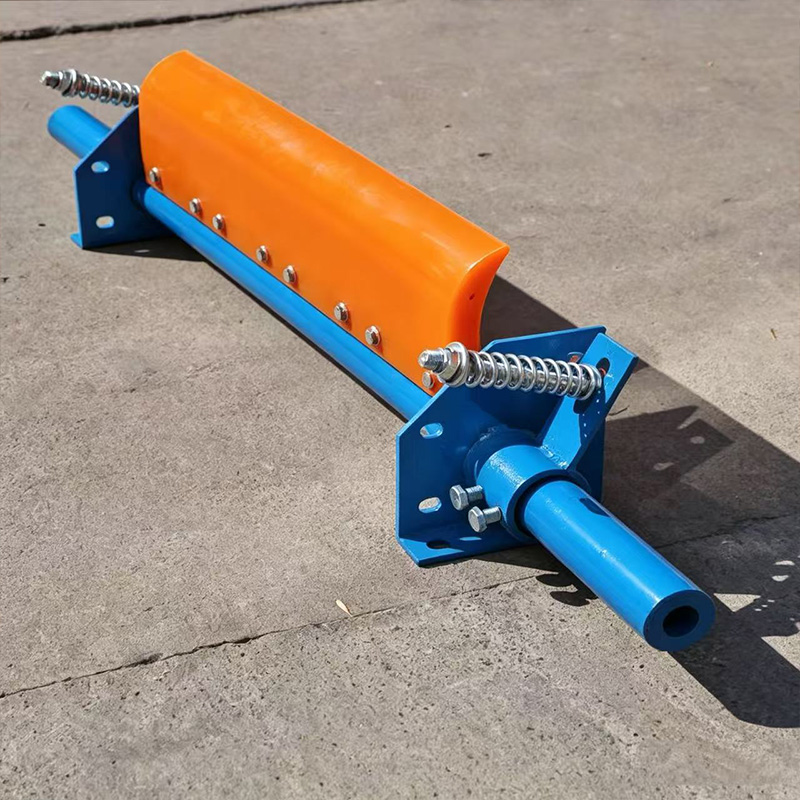
Relying on a single blade to handle all carryback is a fundamental design flaw in modern bulk material handling. Effective systems utilize a staged approach, separating the bulk removal from the final detailing.
Primary cleaners are positioned directly on the face of the head pulley, just below the material trajectory path. Their sole purpose is to shear off the heavy, bulk layer of carryback. A properly specified primary cleaner should remove up to 90% of the material. Because they operate against the curved surface of the head pulley, they require specific tensioning mechanisms—usually torsion or spring-loaded tensioners—that allow the blade to absorb the impact of heavy material flow and mechanical splices without losing contact.
A secondary belt cleaner is positioned immediately after the belt leaves the head pulley and transitions onto the return run. Operating against a flat belt profile, the secondary cleaner acts as a squeegee, removing the remaining fines, dust, and moisture that bypassed the primary blade. Installing a secondary cleaner is a non-negotiable requirement for operations handling wet, sticky, or fine materials. Without it, the microscopic fines will dry on the return run, becoming airborne dust or accumulating on the return idlers. Secondary cleaners often utilize air-shock tensioners to maintain a constant, precise upward pressure against the flat belt.
Standard scraping blades are not suitable for every location on the conveyor or every type of belt. Specialized configurations are required to address specific vulnerabilities in the material handling process.
A V-shaped belt cleaner (often called a V-plow) is specifically designed for the return run of the conveyor, positioned just before the tail pulley. Unlike standard cleaners that scrape material off the carrying side, the V-shaped cleaner deflects fugitive material that has fallen onto the inside of the return belt. If rocks or hard debris become trapped between the belt and the tail pulley, they will puncture the belt from the inside out. The V-plow pushes this debris off the edges of the belt, protecting the tail pulley and preventing catastrophic belt ruptures. These plows must always be secured with a safety cable to prevent them from being dragged into the tail pulley if the primary mounting bracket fails.
For extreme carryback scenarios, grooved belts, or chevron belts where flat scraping is physically impossible, brush cleaners and wash boxes offer niche solutions. Motorized brush cleaners use rotating bristles to sweep material out of cleats and grooves. Wash boxes enclose the return belt in a sealed chamber, utilizing high-pressure water spray bars and multiple squeegee blades to completely wash the belt surface. While highly effective, wash boxes require complex effluent management systems to handle the resulting slurry.
Selecting the correct blade material dictates the balance between cleaning efficiency, blade lifespan, and belt safety. The two dominant materials in the industry are polyurethane and tungsten carbide, each serving distinct operational roles.
A polyurethane belt scraper offers high flexibility and impact absorption. This flexibility makes it highly compatible with mechanical belt splices, as the blade can deform and ride over the metal fasteners without catching or tearing them out. Polyurethane is the industry standard for primary cleaning applications because it is forgiving on the belt cover and can handle the heavy impact of bulk material removal. It is available in different durometer (hardness) ratings. A softer 85A durometer is used for older, worn belts, while a harder 95A durometer is used for high-speed, highly abrasive applications.
Tungsten carbide offers superior wear resistance, maintaining a sharp cleaning edge significantly longer than polyurethane. This hardness makes it exceptionally efficient at removing microscopic fines and moisture. However, this rigidity comes with strict operational limitations. Tungsten carbide is primarily suited for vulcanized belts in secondary cleaning roles. It poses a high risk of catastrophic failure if used on damaged belts or belts with mechanical fasteners, as the rigid metal edge will catch on any raised imperfection, potentially ripping the splice apart or tearing the belt cover.
Feature | Polyurethane Scraper | Tungsten Carbide Blade |
|---|---|---|
Primary Application | Primary cleaning (Head Pulley) | Secondary cleaning (Return Run) |
Splice Compatibility | Excellent for mechanical and vulcanized | Vulcanized only; high risk for mechanical |
Wear Resistance | Moderate (requires regular tensioning) | Extremely high (maintains sharp edge) |
Flexibility | High (conforms to belt profile) | Rigid (requires flat, uniform belt surface) |
The interaction between the cleaning blade and the belt splice is the most critical mechanical risk in the system. Mechanical fasteners (metal lacing or hinges) create a raised, hard profile that strikes the cleaning blade hundreds of times per hour. If a rigid blade catches on a loose or raised fastener, the resulting impact can cause catastrophic failure. The blade mount can be ripped from the chute wall, the blade itself can shatter, or the fastener can be torn from the belt, leading to a complete belt separation and massive operational downtime.
Mitigating this risk requires careful component matching. If mechanical splices are present, operators must specify the use of flexible polyurethane materials that can deform upon impact. You can also skive (recess) the mechanical fastener into the belt cover so it sits flush with the surface, eliminating the strike hazard entirely. Additionally, implementing relief cuts in the blade allows individual segments to flex independently when struck by a fastener, leaving the rest of the blade engaged with the belt. Automated tension-release mechanisms or air-tensioned systems can also provide the necessary give to safely navigate splices without sacrificing overall cleaning pressure.
Moving from a reactive, run-to-failure approach to a predictive maintenance framework is essential for scalable conveyor management. Conveyors have strict maintenance needs and operational limitations that cannot be ignored. Relying on visual spillage to indicate a failed blade guarantees that secondary damage to idlers and tracking systems has already occurred.
Establishing baseline wear rates allows maintenance teams to schedule tensioning adjustments and blade changeouts before cleaning effectiveness drops below acceptable thresholds. Operators should measure the blade profile weekly during the initial month of operation to calculate the exact wear rate per tonnage conveyed. This data informs a scalable maintenance schedule, ensuring blades are tensioned incrementally and replaced during planned outages rather than emergency shutdowns. Documenting these wear patterns also helps identify localized issues, such as off-center loading, which presents as uneven blade wear.
Cleaning systems must operate within the bounds of local environmental regulations and occupational safety standards. Fugitive dust generated by ineffective secondary cleaning is a major compliance violation under regulatory bodies like MSHA and OSHA. Airborne respirable dust poses severe health risks to personnel and creates explosive atmospheres in confined spaces.
Ensuring compliance requires that the cleaning system is fully enclosed within the discharge chute, with appropriate dust curtains and extraction systems in place. When implementing advanced solutions like wash boxes, operators must address the logistics of handling the effluent. The resulting slurry must be piped to a clarifier or settling pond, ensuring that hazardous carryback materials or heavy metals do not contaminate local water systems. Proper guarding around all tensioning mechanisms is also mandatory to prevent entanglement hazards during routine inspections.
To regain control over your conveyor performance, take the following next steps:
Conduct a visual inspection of the head pulley under full material load to identify exact bypass points.
Measure your current carryback volume by placing a collection tarp under the return run for a set operational hour.
Audit all belt splices to ensure compatibility with your current blade materials.
Consult with a conveyor specialist to specify the correct primary and secondary configurations based on your specific tonnage and material moisture content.
A: Premature wear is primarily caused by incorrect profiling against the belt, inadequate or excessive tensioning, and highly abrasive conveyed materials. If the blade angle is wrong, it creates chatter and uneven friction. Over-tensioning generates excessive heat and drag, rapidly degrading the blade edge.
A: Yes, for optimal performance. A primary cleaner removes the heavy, bulk material (up to 90%) at the head pulley. A secondary cleaner acts as a squeegee on the return run to remove the remaining wet fines and dust that the primary blade cannot physically catch.
A: Replacement frequency depends on material abrasiveness, belt speed, and operating hours. Establish a baseline by measuring wear weekly. Replace the scraper when it reaches the manufacturer's wear line or when tensioning adjustments can no longer maintain adequate blade-to-belt contact.
A: Chattering usually indicates an incorrect angle of attack (too aggressive), a lack of structural rigidity in the mounting pole, or a worn blade edge that is catching on belt irregularities. It can also occur if the blade material is too rigid for the specific belt cover.
A: A V-shaped cleaner (V-plow) should be installed flat on the inside of the return belt run, positioned just before the tail pulley. Its purpose is to deflect rocks and fugitive debris off the belt before they get trapped and puncture the belt at the tail pulley.
A: Yes. Over-tensioning creates extreme friction, which can overheat and wear down the belt's top cover. It also significantly increases the risk of the blade catching and tearing out mechanical splices, leading to catastrophic belt failure and high drive motor amperage draw.
A: Mechanical splices require flexible cleaning blades, typically polyurethane, that can deform and glide over the metal fasteners. Rigid materials like tungsten carbide will catch on mechanical splices, causing severe damage to the blade, the mounting hardware, and the splice itself.


