


Views: 0 Author: Site Editor Publish Time: 2026-09-15 Origin: Site


Carryback presents a severe operational risk for mining conveyor systems. It goes far beyond a simple housekeeping issue. Fugitive material clinging to the return belt drives premature idler failure, induces severe belt misalignment, and forces unscheduled downtime across the facility. Selecting an incompatible cleaning system accelerates belt wear, ruins splices, and fails to remove material effectively. This failure creates hazardous fugitive dust and massive spillage along the conveyor line. Mining operators need a systematic, engineering-led framework to evaluate these systems. You must analyze material abrasiveness, belt speed, splice type, and the surrounding operating environment. A single Belt Cleaner rarely solves complex carryback issues alone. This technical evaluation ensures you deploy a solution that maximizes component lifespan, maintains continuous production, and prevents catastrophic equipment failure. Read the following breakdown to specify the exact scraping mechanisms required for your specific material handling challenges.
Effective carryback management requires a multi-stage approach, typically combining a primary belt cleaner at the head pulley with at least one secondary belt cleaner to maximize overall cleaning efficiency.
Blade material selection must align with belt splice types; rigid materials require vulcanized splices, while forgiving materials can accommodate mechanical fasteners.
System variables—including head pulley diameter, belt speed, material type, and moisture content—dictate the required tensioning mechanism and cleaner profile.
A successful belt cleaning system achieves highly specific performance metrics. It reduces carryback to less than one percent of the total conveyed volume. It extends the functional life of conveyor components and maintains strict compliance with safety regulations. Fugitive material escapes the material stream when cleaners fail. This material accumulates rapidly under the conveyor structure, creating a chain reaction of mechanical and safety failures.
Effective carryback management directly prevents hazardous material spillage. Spillage creates immediate slip and trip hazards for maintenance personnel walking the conveyor line. It obstructs walkways and obscures structural damage on the conveyor frame. Removing this material manually exposes workers to moving machinery, pinch points, and respirable dust. Proper cleaning mechanisms keep the material in the discharge chute. This maximizes product yield and eliminates the need for dangerous manual cleanup operations. Regulatory bodies routinely issue severe citations for the accumulation of combustible materials, particularly in coal handling facilities. A well-designed scraping system mitigates this compliance risk entirely.
Carryback triggers a cascade of mechanical failures across the entire conveyor profile. Wet, abrasive material sticks to the belt and transfers directly to the return idlers. This buildup increases the diameter of the idler unevenly. Uneven idlers force the belt to track off-center. Severe misalignment causes the belt edges to rub against the steel conveyor structure. This friction strips the rubber cover and destroys the internal fabric carcass.
Furthermore, abrasive grit from the carryback penetrates the labyrinth seals of the return idlers. The grit mixes with the factory grease, creating a highly abrasive lapping compound. This paste destroys the internal ball bearings, causing the idler to seize completely. The moving belt then grinds against the stationary steel shell of the seized idler. Eventually, the shell wears through, creating a razor-sharp edge that slices the belt longitudinally. A seized idler also acts as a brake, drastically increasing the power consumption and thermal load on the main drive motor.
Fugitive material drains profitability through hidden operational costs. Manual cleanup labor requires dedicated personnel, skid steers, and specialized vacuum trucks. Lost product yield directly impacts the bottom line, especially in high-value commodity mining like copper or gold. Accelerated equipment depreciation forces the early replacement of belts, idlers, and pulleys. Calculating these metrics reveals the true financial burden of inadequate cleaning systems. Investing in robust scraping mechanisms prevents these compounding financial losses and keeps maintenance personnel focused on preventative tasks rather than reactive shoveling.
Carryback Severity | Estimated Volume (Tons/Week) | Primary Operational Risk | Required Intervention |
|---|---|---|---|
Light (Dust only) | 0.5 - 1.0 | Airborne particulate compliance | Secondary scraping only |
Moderate (Fines) | 2.0 - 5.0 | Return idler bearing failure | Primary and secondary combination |
Severe (Heavy mud/clay) | 10.0+ | Catastrophic belt misalignment | Primary, dual secondary, and wash box |
Managing carryback requires multiple cleaning stages. Material characteristics change as the belt travels through the discharge zone and flattens out on the return run. A single blade cannot handle both heavy bulk and sticky fines effectively. You must deploy specific blade profiles at designated locations along the conveyor discharge.
Operators mount the primary belt cleaner directly on the face of the head pulley. It sits just below the material trajectory, typically between the 3 o'clock and 4 o'clock positions. Its objective is shearing off the top sixty to seventy percent of coarse, heavy carryback. It removes this bulk material before it leaves the discharge chute, allowing it to fall naturally into the primary material stream.
The primary blade attacks the belt at a peeling angle. This angle separates the material stream without applying excessive pressure to the belt cover. Because the belt is under high tension and stretched over the curvature of the pulley, the rubber surface becomes slightly porous. The primary blade cannot press hard enough to clean these micro-pores without damaging the belt. Proper blade-to-belt contact prevents material from wedging between the blade and the belt. Wedged material causes rapid, localized belt wear and destroys the scraping edge.
The secondary belt cleaner mounts just past the point where the belt leaves the head pulley and flattens out. Operators often install it further down the return run, provided the scraped material can still be directed into the main discharge chute. Its objective is removing the remaining thirty to forty percent of sticky, fine materials and residual moisture.
Secondary blades operate at a scraping angle. They sit perpendicular or slightly angled against the belt travel direction, acting like a squeegee. High-tonnage mining applications strictly require pairing primary and secondary units. The primary unit removes the heavy volume, allowing the secondary unit to achieve peak cleaning efficiency on the embedded fines. Without a primary unit, the heavy bulk material will simply overpower and fold the secondary blade.
Severe applications demand tertiary cleaning stages to protect specific conveyor components. V-plows mount on the internal return run, just before the tail pulley. They deflect fugitive material off the inside of the belt, preventing rocks from getting trapped between the belt and the tail pulley. Diagonal plows serve a similar function on one-sided discharge systems.
Motorized brush cleaners handle specific environmental challenges. They excel at cleaning ribbed belts or chevron cleats where standard flat blades cannot penetrate. The rotating bristles sweep dry, powdery fines effectively. However, brush cleaners struggle with wet, cohesive clay, which quickly packs into the bristles and renders the unit useless.
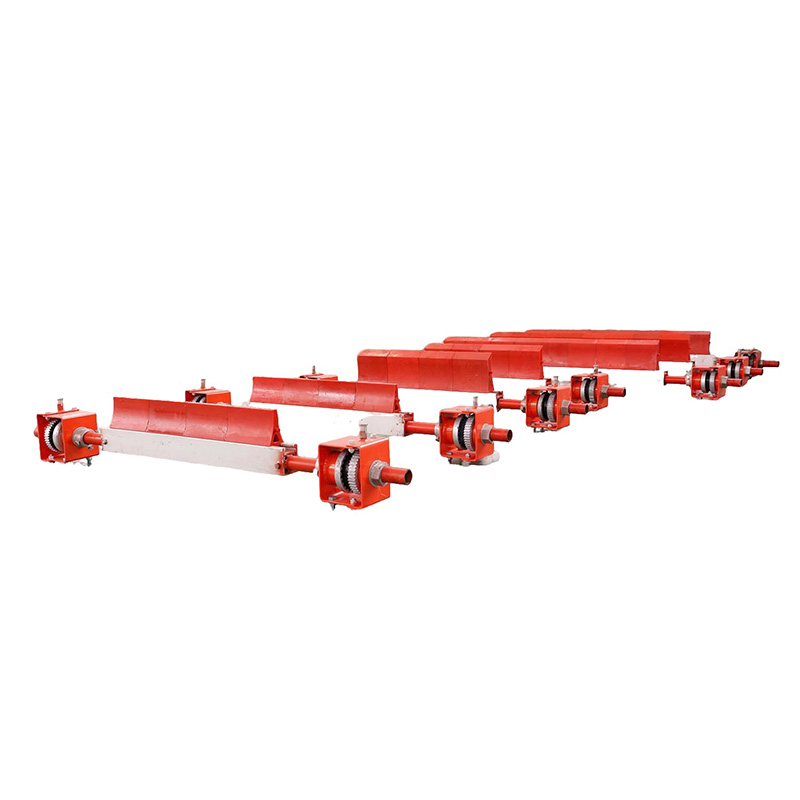
Blade material dictates cleaning efficiency and belt safety. The choice depends entirely on the material conveyed and the type of belt splice used. Selecting the wrong material guarantees either poor cleaning performance or catastrophic belt damage.
Polyurethane offers excellent chemical and abrasion resistance. A polyurethane belt scraper provides a forgiving, flexible cleaning edge. This flexibility makes it highly compatible with mechanical splices. The blade yields slightly when a metal fastener passes over it. This prevents the blade from catching the fastener and tearing the splice out of the belt carcass.
Polyurethane does have strict temperature limitations. High belt speeds generate friction heat. If the belt runs dry, standard polyurethane heats up rapidly. At elevated temperatures, the material begins to revert. It melts, smears across the belt cover, and loses all scraping capabilities. Operators must select the correct durometer for the mined material. Softer durometers (around 85 Shore A) handle wet, sticky coal and conform well to worn belts. Harder durometers (up to 95 Shore A) resist the cutting action of jagged iron ore and crushed granite.
Tungsten carbide delivers superior cleaning efficiency and provides an exceptionally long wear life in highly abrasive applications. A carbide blade belt cleaner maintains a sharp scraping edge far longer than any elastomer. It slices through sticky clay and handles high-speed, dry friction without melting.
However, carbide carries a severe implementation risk. Carbide blades strictly require vulcanized splices. The rigid metal edge has zero yield. If a mechanical fastener hits a carbide tip, the impact force transfers directly to the fastener rivets. This collision rips the rivets through the belt carcass, causing catastrophic splice tear-outs and severe downtime. Operators must evaluate the application carefully. Carbide lowers maintenance frequency in abrasive environments like copper or gold mining, but the belt must be entirely free of mechanical repairs.
Feature | Polyurethane Blades | Tungsten Carbide Blades |
|---|---|---|
Splice Compatibility | Mechanical and Vulcanized | Vulcanized ONLY |
Abrasion Resistance | Moderate to High | Extreme |
Impact Resistance | High (Yields to impact) | Low (Brittle under heavy impact) |
Friction Heat Tolerance | Low (Melts at high temps) | High (Unaffected by standard friction) |
Specifying a cleaning system requires precise physical measurements of the conveyor structure. Guesswork leads to poor performance, excessive vibration, and equipment damage.
High belt speeds generate substantial friction and kinetic energy. Speeds exceeding one thousand feet per minute require specific blade formulations. Standard polyurethane suffers thermal degradation at these speeds, requiring high-temp urethane blends or carbide alternatives. Belt width dictates the structural rigidity of the cleaner mainframe. A seventy-two-inch belt requires a massive, reinforced mounting pole. Weak mainframes deflect under the heavy material load. This deflection causes the blade to vibrate and chatter against the belt. Chattering destroys the blade edge, damages the belt cover, and loosens the mounting hardware.
The head pulley diameter influences the required blade profile for primary cleaners. Large diameter pulleys require a different mounting footprint and blade curvature than small pulleys. The blade must match the exact curvature of the pulley to maintain consistent, even contact across the entire face.
Operators must measure the material path, not just the total belt width. The material path is the actual width of the load carried on the belt. Because troughing idlers form a cup, the material sits in the center of the belt. The material path is usually six to twelve inches narrower than the total belt width. The cleaner blade should only cover the material path, plus a two-inch margin on either side for belt wander. Extending the blade across the clean, dry edges of the belt causes unnecessary friction. It wears the belt edges prematurely and degrades the outer edges of the blade, creating a "smile" profile that allows carryback to pass through the center.
Run the conveyor under normal load conditions.
Observe the discharge point and identify the wet, dirty footprint on the belt cover.
Measure the width of this dirty footprint accurately.
Select a blade width that matches this measurement, adding no more than two inches per side.
Mined materials exhibit vastly different handling characteristics. Sticky clay requires a thin, sharp blade to slice the material away from the belt cover. Wet coal tends to blind thick blades. It builds up on the leading edge and pushes the blade away from the belt surface. Jagged quartz requires a highly abrasion-resistant material to prevent rapid blade consumption. The blade profile must encourage scraped material to flow smoothly down into the chute without accumulating on the tensioner mechanism or the mainframe.
Surface and underground environments impose different constraints on equipment selection. High wall quarries expose equipment to intense UV radiation, extreme weather, and sub-zero temperatures. Cold environments require specialized polyurethane that remains flexible below freezing, preventing the blade from becoming brittle and shattering under impact.
Underground coal mines operate under strict regulatory requirements. They require anti-static and fire-retardant (FRAS) polyurethane formulations. These specialized materials prevent static discharge buildup and eliminate ignition sources in explosive atmospheres containing methane and coal dust. Standard polyurethane is strictly prohibited in these underground applications.
A blade only works if it maintains optimal contact pressure against the belt. The tensioning system provides this continuous pressure and absorbs impact shocks from heavy splices or tramp metal.
Spring tensioners offer reliable, linear pressure. They are simple to install and highly durable. However, they require manual adjustment as the blade wears down. Maintenance personnel must physically tighten the springs to maintain the correct blade-to-belt contact.
Air or pneumatic tensioners provide constant, self-adjusting pressure. They connect directly to the plant air supply and maintain optimal blade contact automatically, regardless of blade wear. This eliminates the need for manual adjustments, making them ideal for hard-to-reach locations.
Rubber torsion mounts absorb severe impacts from heavy belt splices or tramp metal. They twist to relieve pressure during an impact and snap back into position immediately. Consistent blade-to-belt pressure is critical for all types. Under-tensioning allows material to pass under the blade, defeating the purpose of the cleaner. Over-tensioning generates excessive heat, accelerates blade wear, and damages the belt cover.
Tensioner Type | Maintenance Requirement | Best Application |
|---|---|---|
Coil Spring | High (Manual adjustment needed) | Standard surface mining, easy access areas |
Pneumatic / Air | Low (Self-adjusting) | Inaccessible areas, high-wear applications |
Rubber Torsion | Medium (Periodic checks) | Belts with heavy mechanical splices |
Maintenance access dictates the long-term success of the installation. A cleaner that is difficult to reach will not receive proper adjustment or timely blade replacements. Slide-out cartridges allow technicians to pull the entire blade assembly outside the conveyor frame. This eliminates the need to reach into confined spaces or remove heavy chute access doors.
Visual wear indicators tell operators exactly when to schedule a blade replacement without guessing. Tool-less blade replacement systems utilize pin-and-clip mechanisms, reducing maintenance time from hours to minutes. Underground mining and transfer towers feature severe confined space restrictions. Cleaners in these locations must feature external adjustment mechanisms and modular blade segments that can be carried easily up narrow stairwells.
Selecting the right hardware is only part of the equation. The ongoing availability of consumable parts and technical support determines the long-term viability of the cleaning system.
Choosing the cheapest initial option often results in higher operational costs due to frequent blade replacements, continuous spillage, and excessive manual cleanup. The cleaner blade is a sacrificial component. It is designed to wear out so the conveyor belt does not. Investing in high-quality, application-specific blades extends the replacement interval. This reduces the frequency of maintenance shutdowns and keeps the conveyor running at peak capacity.
Evaluate the importance of localized inventory for consumable parts. Mining operations cannot wait weeks for replacement blades to ship from overseas. Partner with vendors who maintain local stock of the specific durometers and blade profiles required for your facility. Vendor-provided site audits ensure the correct hardware is specified for each individual conveyor. Ongoing maintenance training from the vendor ensures your site personnel understand how to tension the specific mechanisms correctly, preventing premature wear and equipment damage.
There is no universal belt cleaner. The optimal choice remains a highly specific engineering decision based on splice type, material characteristics, operating environment, and pulley geometry. Identify your splice type first, measure your head pulley diameter, calculate your belt speed, and define the exact material path. Determine the required combination of primary and secondary units to handle your specific tonnage and moisture content.
Conduct a comprehensive conveyor walk-down to identify all carryback accumulation zones and document current spillage volumes.
Verify the splice type on every conveyor belt before ordering replacement blades to prevent catastrophic tear-outs.
Measure the actual material path under load to ensure you specify the correct blade width and avoid dry friction on the belt edges.
Consult with a specialized conveyor component engineer for a site-specific hardware audit and tensioner calibration.
A: A primary cleaner mounts directly on the head pulley to shear off coarse, heavy bulk material using a peeling angle. It handles the majority of the volume. A secondary cleaner mounts further down the flat return run. It uses a scraping angle to remove fine, sticky residue and moisture. Using both maximizes overall cleaning efficiency.
A: No. You must strictly avoid this combination. The rigid carbide edge has zero yield and will catch the metal mechanical fasteners. This collision rips the fasteners out, destroying the splice and causing catastrophic belt failure. Use flexible polyurethane blades for mechanically spliced belts.
A: Replacement frequency depends heavily on material abrasiveness, belt speed, and tensioner pressure. Do not rely on exact timelines. Monitor the visual wear indicators on the tensioner mechanism. Replace the blade immediately when you observe a significant loss of cleaning efficiency or increased carryback accumulation.
A: Chattering usually results from incorrect tensioning or an improper angle of attack against the belt. It also occurs if the belt speed exceeds the thermal limits of the blade material, causing it to grip and release rapidly. Additionally, a weak mainframe lacking structural rigidity will vibrate under heavy material loads.
A: Always follow the manufacturer's specific pressure guidelines based on the blade material and the measured belt width. Over-tensioning causes premature blade wear, generates dangerous friction heat, and damages the belt cover. Under-tensioning allows material to wedge beneath the blade, defeating the cleaning process.
A: Tungsten carbide blades provide the best performance for highly abrasive materials like crushed quartz or iron ore. They require a fully vulcanized belt splice. Pair them with heavy-duty spring or rubber torsion tensioners designed to withstand severe-duty environments and high-speed friction.


